Principles of Property Division after Divorce in Vietnam
Divorce is a challenging process, especially when it comes to difficult discussions and tough decisions surrounding property division matters. Unfortunately, the situation is not always ideal, with asset disputes complicating the process. Understanding your legal rights in property division is crucial to ensure fairness and protect what matters most to you.
In this article, TNP Lawyers will provide a clear explanation of Vietnam’s property settlement laws by breaking down law provisions into key principles to ensure you are well-informed of this complex issue.
16 03 2025
Divorce is a challenging process, especially when it comes to difficult discussions and tough decisions surrounding property division matters. Unfortunately, the situation is not always ideal, with asset disputes complicating the process. Understanding your legal rights in property division is crucial to ensure fairness and protect what matters most to you.
In this article, TNP Lawyers will provide a clear explanation of Vietnam’s property settlement laws by breaking down law provisions into key principles to ensure you are well-informed of this complex issue.
To gain a comprehensive understanding of the article, it is crucial to grasp these key concepts in terms of Vietnamese law:
What is Divorce under Vietnamese Law?
According to Clause 14, Article 3 of the Law on Marriage and Family 2014, divorce means termination of the husband and wife relation under a court’s legally effective judgment or decision.
In Vietnam, divorce cases typically fall into two categories, resolved through two different forms of court settlement:
Mutual consent divorce: Both spouses agree to end the marriage and reach a voluntary agreement on division of assets, child custody, and support. If the spouses fail to reach agreement or have reached an agreement that fails to ensure the legitimate interests of the wife and children, the court shall settle the divorce.
Unilateral divorce: This occurs when one spouse wishes to end the marriage without the consent of the other. One spouse can file for divorce if the other has committed faults such as adultery, abusive behavior, or other serious offenses that make the continuation of the marriage intolerable (i.e., fault-based divorce). When resolving a divorce at the request of one party, the court will settle the case following the procedures for settling civil cases.
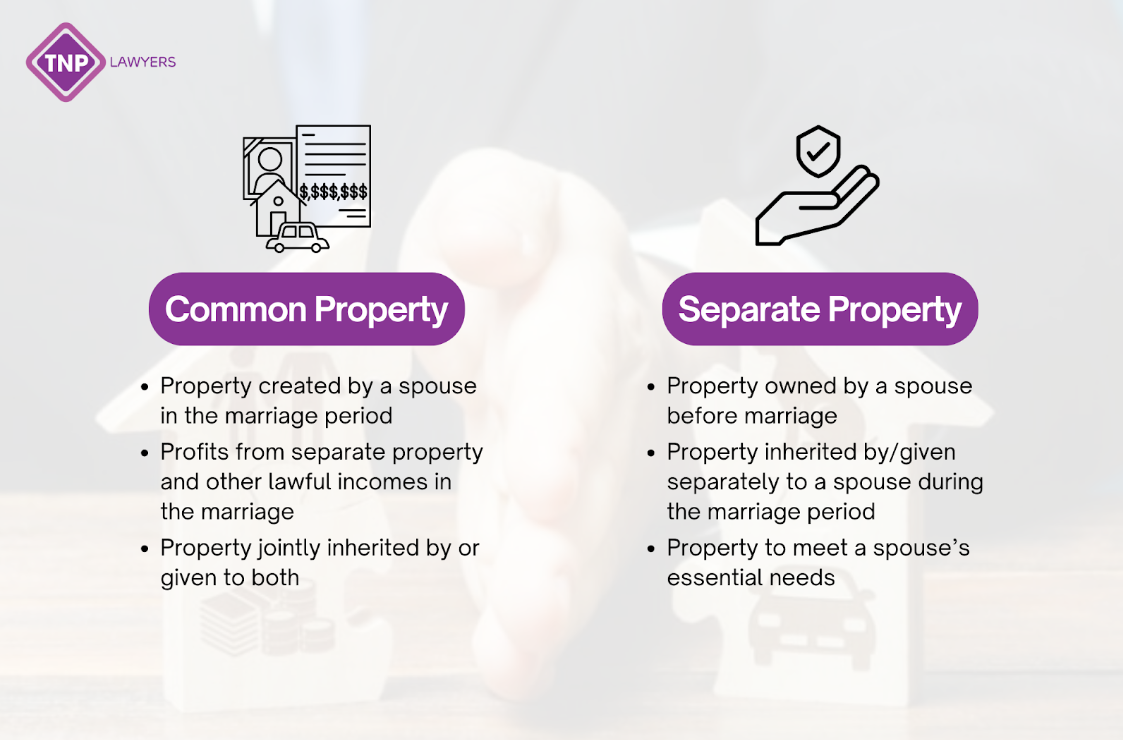
Article 33 of the Law on Marriage and Family 2014 stipulates that common property of husband and wife includes property created by a spouse, incomes generated from labor, production and business activities, yields and profits arising from separate property and other lawful incomes in the marriage period; property jointly inherited by or given to both, and other property agreed upon by husband and wife as common property.
The land use rights obtained by a spouse after marriage shall be considered a jointly owned marital asset of husband and wife, unless they are separately inherited by, or given to a spouse, or are obtained through transactions made with separate property.
When there exists no ground to prove that a property in dispute between husband and wife is his/her separate property, such property shall be regarded as common property.
Regarding separate property, article 43 of the Law on Marriage and Family 2014 stipulates: Separate property of a spouse includes property owned by this person before marriage; property inherited by or given separately to him/her during the marriage period; property divided separately by agreement of the spouses dividing a part or whole of common property; property to meet his/her essential needs and other property under his/her ownership as prescribed by law. Property created from separate property of a husband or wife is also property of his/ her own.
Common Property & Separate Property.
4 PRINCIPLES OF PROPERTY DIVISION UPON DIVORCE IN VIETNAM
According to Circular 01/2016/TTLT-TANDTC-VKSNDTC-BTP dated 06/01/2016, spouses have the right to mutually agree on all issues, including the division of assets, upon divorce. It is worth noting that notarization of property agreements is required for them to be legally valid and enforceable. If they fail to reach a mutual property settlement agreement, at the request of a spouse or both, a court shall settle it by deciding whether to apply the agreed matrimonial property regime or the statutory matrimonial property regime.
In case the agreed matrimonial property regime is applied, court settlement of property division upon divorce must comply with such agreement. In case the agreement is insufficient, unclear or invalidated by the court, the following principles are applied to the settlement (Articles 59, 60, 61, 62, 63, and 64 of the Law on Marriage and Family):
Principle 1. Common property shall be divided into two, taking into account the following factors to determine the proportion each spouse receives:
a/ Circumstances of the family, husband and wife: The state of legal capacity, behavioral capacity, health, property, and the ability to work and generate income after the divorce of a spouse, as well as that of other family members for whom the spouses have personal and financial obligations in accordance with the Law on Marriage and Family. The party facing more difficulties after the divorce is entitled to a larger share of the property than the other party, or is given priority to receive the type of property necessary to ensure the maintenance and stability of their lives. Such distribution must align with the actual circumstances of the family and both spouses.
b/ Contributions of spouses to common property: This encompasses the contributions of each spouse’s personal property, income, housework and labor towards the creation, maintenance, and development of common property. A spouse who stays home to take care of the family and manage the household is considered an employee with income equivalent to that of a working husband or wife. The party with greater contributions to common property will be entitled to a larger share of the property.
c/ Protection of legitimate interests of each spouse in their production, business and career activities to continue generating incomes: The division of common property must ensure that husband and wife who are engaged in professional activities can continue to practice their profession; husband and wife who are engaged in production and business activities may continue to produce and do business to generate income and must pay the other party the difference in property value. Such protection must not compromise the minimum living conditions of spouses and minor children; as well as adult children who have lost their legal capacity for civil acts.
d/ Each spouse’s faults in the infringement of spousal rights and obligations: When dividing property upon divorce, faults such as domestic violence and infidelity are taken into account by the court to decide on the division ratio of common assets. For example, in case the husband commits domestic violence, unfaithfulness, or property dissipation, when settling divorce, the court must consider the husband’s fault when dividing the common property to ensure the legitimate rights and interests of the wife and minor children.
Principle 2. Common property of husband and wife shall be divided in kind if possible; otherwise, common property shall be divided based on its value. The partner who receives the property in kind with a value bigger than the portion he/she is entitled to receive shall pay the value difference to the other.
For example, in a divorce settlement, the spouse receiving a full property (e.g., a shared apartment) whose value exceeds his/her entitled share must compensate the other with a cash payment equivalent to that excess value.
Principle 3. Separate property of a spouse shall be under his/her ownership, except for separate property already merged into common property in accordance with the Law on Marriage and Family. A spouse who requests division of separate property which has been merged into or mixed with common property shall be paid for the value of his/her property contributed to common property, unless otherwise agreed by husband and wife.
For example, if a wife uses her pre-marriage savings of VND 500,000,000 to buy a family vacation house, her separate property is merged into common property. Upon divorce, she can request compensation for her original contribution, receiving VND 500,000,000 from the common property.
Principle 4: The lawful rights and interests of the wife, minor children or adult children who have lost their civil act capacity or have no working capacity and no property to support themselves shall be protected.
For example, in a divorce settlement, the court might allocate a larger share of property to the custodial parent of minor children. This helps the parent fulfill his/her caregiving obligations in essential areas for the children. The principle ensures that child custody is directly linked with property division decisions, while the financial rights of minor children are thoroughly protected upon divorce.
Principle 5: Market value assessment is the primary method used to determine the value of property during division: Assets are typically valued based on their market value at the time of division to ensure fairness in the settlement process. For example, in the case of real estate, the value is determined based on its prevailing market price at the time of divorce. Meanwhile, certain assets such as shares, land use rights, or business assets may require appraisal by experts of the relevant field.
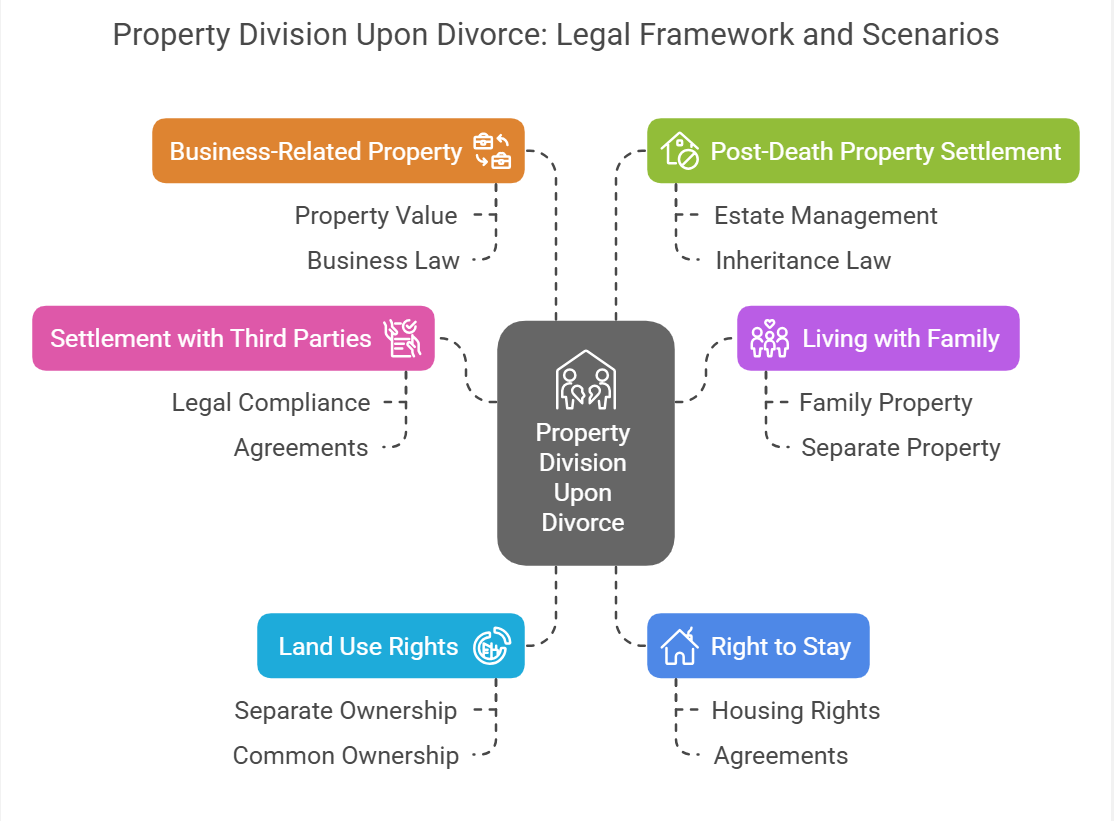
OTHER ASPECTS OF PROPERTY DIVISION UPON DIVORCE
Settlement of Property Rights and Obligations Involving a Third Party
Property rights and obligations of husband and wife toward a third party remain effective after divorce, unless otherwise agreed by all parties involved. When a dispute arises over property rights and obligations, the settlement of such dispute must comply with Articles 27, 37 and 45 of the Law on Marriage and Family and the Civil Code.
Division of Property for a Couple Living with Their Family
When a couple living with their family get a divorce, if their property cannot be determined separately from the common property of the family, the husband or wife is entitled to division of part of the family’s common property based on the couple’s contributions to the creation, maintenance and development of the family’s common property as well as to the common life of the family.
For a couple living with their family whose property can be determined separately from the family’s common property, upon divorce, such property portion of the couple shall be deducted from the family’s common property in accordance with Article 59 of the Law on Marriage and Family.
Division of Land Use Rights
Land use rights being separate property of a spouse remain under his/her ownership upon divorce. The division of land use rights being common property of husband and wife upon divorce shall be divided in accordance with the provisions of Clause 2, Article 62 of the Law on Marriage and Family.
For husband and wife living with their family and sharing no land use rights with the latter, upon divorce, the interests of the partner who has no land use rights and does not continue to live with the family shall be settled according to Article 61 of the Law on Marriage and Family.
The Right to Stay of a Spouse upon Divorce
A house which is separate property of a spouse and has been put to common use remains under his/her ownership upon divorce. In case the other partner has accommodation difficulties, unless otherwise agreed by the partners, he/she has the right to stay at the house for 6 months at most from the date of termination of the marriage relation.
Division of Common Property Used for Business Activities
A spouse who is carrying out business activities related to common property has the right to receive that property and shall pay the other the property value that the latter is entitled to, unless otherwise prescribed by the business law.
Property Settlement in the Event of a Spouse’s Death
When a spouse is dead or declared to be dead by a court, the other shall manage common property, unless another person is designated to manage the estate under his/her testament or the heirs agree to designate another person to manage the estate.
When there is a request for division of the estate, unless the couple has reached voluntary agreement on the property regime, common property of husband and wife shall be divided into two. The property portion of the spouse who is dead or declared to be dead by a court shall be divided in accordance with the inheritance law.
In case the division of the estate would seriously affect the life of the living spouse and the family, this spouse has the right to request a court to restrict the division of the estate in accordance with the Civil Code.
ADDITIONAL CONSIDERATIONS
Tax Implications of Property Division upon Divorce
Tax considerations are an often-overlooked but important aspect of property division. Transferring or selling assets, such as real estate, may trigger capital gains tax or other liabilities. Shared assets like business interests or investment accounts might also come with tax obligations. To avoid unexpected financial burdens and plan accordingly, it is advisable for you to consult your specific case with a financial advisor or lawyer.
Planning for the Future
Divorce is not just about resolving immediate issues—it’s also about preparing for the future. Property agreements should account for long-term needs, such as child-related expenses, education costs, or retirement savings. Flexibility in these arrangements is equally important, as circumstances like career changes or economic shifts may require adjustments over time. Thoughtful planning today can help ensure financial stability and reduce potential conflicts in the future.
The Role of Mediation
Mediation can be an effective option for addressing disputes over property division upon divorce. It allows both parties to cooperatively and privately negotiate the division of assets, hence saving time and costs compared to court proceedings. However, ensuring fairness in mediated agreements is essential. Having legal guidance during mediation can help you navigate complex property issues, such as valuing assets or addressing joint ownership of marital property, while safeguarding your legitimate rights.
CONCLUSION
Understanding the regulations governing property division upon divorce, as well as factors influencing property division decisions, is crucial to protect your legal rights and achieve a fair distribution of assets. Vietnamese law provides clear guidelines for dividing common and separate property, while also considering individual circumstances, contributions, and the well-being of vulnerable parties. By familiarizing yourself with Vietnam’s legal framework for divorce, you can navigate this challenging process with greater confidence and clarity, should you ever find yourself in such a situation.