Every divorce brings uncertainty and emotional challenges, but parents share one common goal: ensuring their children continue to feel loved and secured during this challenging transition. Recognizing the profound impact of divorce on families, Vietnam Law on Marriage and Family 2014 established a comprehensive legal basis for parental responsibilities regarding child support, prioritizing the protection of children’s rights and well-being.
For divorcing parents without a legal background, understanding these provisions can be overwhelming. In this article, TNP Lawyers will provide a systematic look into child support obligations post divorce in Vietnam, aiming to help readers gain a clear understanding of the matter.
Child Support Obligation after Divorce in Vietnam: an Overview
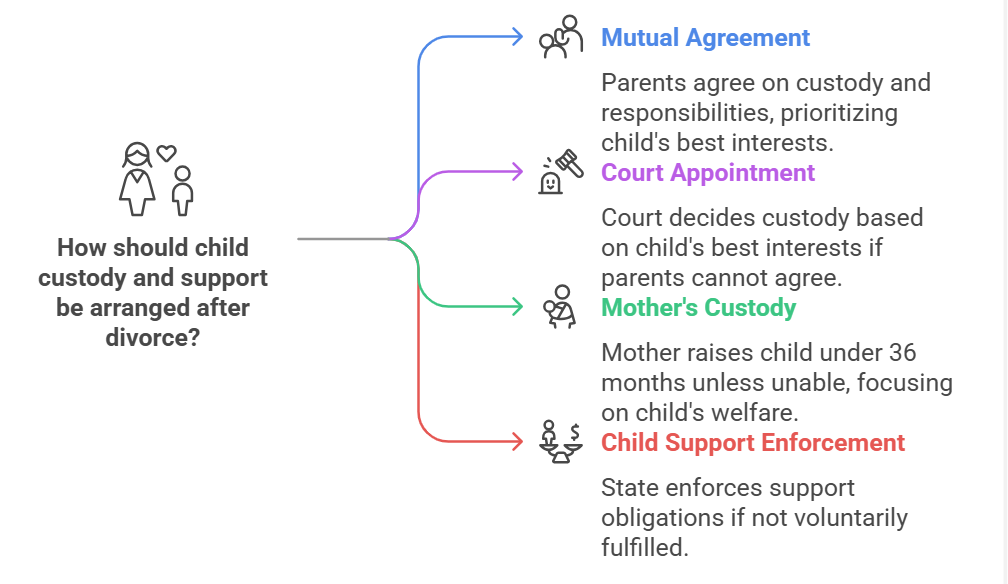
Article 81 in Vietnam Law on Marriage and Family 2014 stipulates that after a divorce, parents still have rights and obligations to look after, raise and educate minor children or adult children who have lost their civil act capacity or have no working capacity and no property to support themselves, in accordance with relevant laws.
Husband and wife shall reach agreement on the person who directly raises their children and on his and her obligations and rights toward their children after divorce. If they fail to reach agreement, the court shall appoint either of them to directly raise the children, taking into account the children’s benefits in all aspects. If a child is full 7 years or older, his/her desire shall be considered.
A child under 36 months of age shall be directly raised by the mother, unless the mother cannot afford to directly look after, care for, raise and educate the child or otherwise agreed by the parents in the interests of the child.
The performance of child support obligations of parents who do not directly raise children is encouraged by the State to voluntarily perform. If the person with the support obligation fully satisfies the judgment enforcement conditions but fails to voluntarily execute the judgment, he/she shall be subject to coercive judgment execution according to law provisions.
Related articles:
The comprehensive guide about unilateral divorce in Vietnam
Vietnam’s divorce rate: Trends and Legal Aspects
Obligations and Rights of Custodial and Non-custodial Parent
For the parent who does not directly raise children after divorce
Pursuant to Article 82 in Vietnam Law on Marriage and Family, the parent who does not directly raise children after divorce (non-custodial parent) has the obligation to respect the child’s right to live with the person who directly raises him/her (custodial parent), and the obligation to support the child. The support level shall be discussed in the next subsection.
The non-custodial parent also has the right and obligation to visit and care for this child without being obstructed by any person, including the custodial parent.
For the parent directly raising children after divorce
Article 83 in Vietnam Law on Marriage and Family stipulates that the parent directly raising children after divorce (custodial parent) has the obligation to not obstruct the person not directly raising the child from visiting, caring for, raising and educating this child.
On the other hand, the custodial parent’s rights include: requesting the non-custodial parent to fulfill the aforementioned obligations and to respect his/her right to raise the child; requesting a court to restrict the right of the latter if this party takes advantage of his/her visit and care for the child to adversely affect the raising and education of this child.
In Vietnam, child custody arrangements typically assume mothers will be the primary caretakers, while fathers often face social pressure regarding financial responsibilities towards children. Addressing these deeply rooted cultural expectations is essential to ensure that both parents, regardless of their roles, can fulfill their obligations and effectively prioritize children’s well-being post-divorce.
Determining the Level and Method for Child Support
Support level
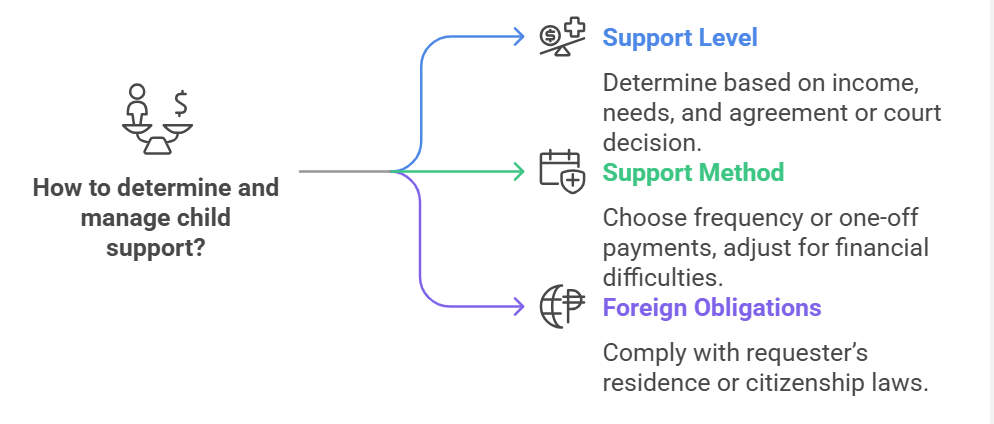
The support level shall be agreed upon by the parent with the support obligation and the supported child, or the latter’s guardian, on the basis of the actual income, ability of that parent, and the essential needs of the child. Child support shall cover all expenses for the child’s upbringing and education, as agreed upon by both parents. If they fail to reach an agreement, they may request a court to settle it.
Besides, Article 115 of Vietnam Law on Marriage and Family stipulates that after divorce, a spouse experiencing financial hardship may request maintenance from the other spouse, provided the reasons are legitimate and the requesting spouse cannot support themselves. The supporting spouse must provide such maintenance in accordance with his/her financial capacity. This maintenance (or alimony) is distinct from, but often closely related to, child support obligations following divorce.
Regarding the minimum child support amount, Clause 2, Article 7 of Decree No. 01/2024/NQ-HDTP provides updated guidelines on child support calculation post-divorce, serving as a legal enforcement of child support level. To be specific, the court-determined child support amount cannot be less than half of the minimum regional wage in the paying parent’s place of residence, per month, for each child.
When there is a plausible reason, the support level may change. The change of the support level shall be agreed upon by the parties; if they fail to reach agreement, they may request a court to settle it.
Support method
Based on the established support agreements post-divorce, support may be provided on a monthly, quarterly, biannual, annual or one-off basis. In case the person with the support obligation falls into a difficult financial circumstance, thus being unable to perform his/her support obligation, the parties may reach agreement to change the method of support or temporarily cease the support; if they fail to reach agreement, they may request a court to settle it.
Support obligation involving foreign elements
Pursuant to Article 129 in Vietnam Law on Marriage and Family, the support obligation must comply with the law of the country where the requester for support resides. In case the requester for support has no place of residence in Vietnam, the law of the country of his/her citizenship shall apply.
Protecting Children’s Rights and Interests
Restrictions on parents’ rights toward their minor children
A parent shall have his/her rights toward a minor child restricted when:
a/ He/she is convicted of one of the crimes of intentionally infringing upon the life, health, dignity or honor of this child or commits acts of seriously breaching the obligations to look after, care for, raise and educate children;
b/ He/she disperses property of the child;
c/ He/she leads a depraved life;
d/ He/she incites or forces the child to act against law or social ethics.
On a case-by-case basis, a court shall intervene by issuing a decision that disallows a parent to look after, care for and educate a child or manage the child’s own property or act as the child’s representative at law for between 1 and 5 years.
Legal consequences of restriction on parents’ rights toward their minor children
When a parent has his/her rights toward a minor child restricted by a court, the other parent shall exercise the rights to look after, raise, care for and educate this child, manage the child’s own property and act as the child’s representative at law.
A guardian shall be assigned to look after, care for and educate a minor child and manage the child’s own property in accordance with the Civil Code and this Law in the following cases:
a/ Both parents have their rights toward the minor child restricted by a court;
b/ The parent who does not have his/her rights toward the minor child restricted does not have sufficient conditions to perform the rights and obligations toward the child;
c/ A parent has the rights toward the minor child restricted and the other parent of the child has not been identified yet.
A parent who has the rights toward a minor child restricted by a court shall still perform the obligation to support this child.
Child support enforcement procedures
Pursuant to Clause 1, Article 119 of the Vietnam Law on Marriage and Family, the supported person, his/her parent or guardian has the right in accordance with the civil procedure law to request a court to force the person who fails to voluntarily perform the support obligation to perform such obligation. If the person with the obligation to provide child support continues to deny or evade parental responsibility, he/she will be strictly penalized in accordance with Decree No. 144/2021/ND-CP and Criminal Code 2015. Specifically:
According to the provisions of Clause 2, Article 57 of Decree No. 144/2021/ND-CP, the act of denying or evading child support obligations between husband and wife after divorce can be fined from VND 5.000.000 to VND 10.000.000.
In addition, in case such evasion of child support obligation causes the child to face serious bodily harm, the offender can be prosecuted for criminal liability in accordance with Article 186 of the Criminal Code 2015 (amended and supplemented in 2017). They shall receive a warning and face up to 02 year’s community sentence or 03-24 months of imprisonment.
Changes in Child Support Obligation
Change of the person directly raising children after divorce
A court may decide to change the person directly raising a child at the request of the following persons, agencies or organizations:
a/ A parent;
b/ Next of kin;
c/ The state management agency in charge of families;
d/ The state management agency in charge of children;
e/ The women’s union.
Change of the person directly raising a child shall be settled when there is one of the following grounds:
a/ The parents agrees on change of the person directly raising a child in the interests of this child;
b/ The person directly raising the child no longer has sufficient conditions to directly look after, care for, raise and educate the child.
Upon change of the person directly raising a child aged full 7 or older, this child’s desire shall be taken into account.
When both parents fail to have sufficient conditions to directly raise a child, a court shall decide to assign this child to a guardian in accordance with the Civil Code.
Termination of support obligation
The support obligation shall terminate in the following cases:
a/ The supported person has become adult and has working capacity or property to raise himself or herself;
b/ The supported person is adopted;
c/ The supporting person directly raises the supported person;
d/ The supporting or supported person dies;
e/ Other cases prescribed by law.
If a child over 18 years old has no working capacity or civil capacity (e.g., due to health challenges, disabilities, or other impediments), and has no means to support themselves financially, parents’ support obligations shall continue beyond this age. This counters the common misconception that all parental financial responsibilities cease once a child reaches 18 years old.
Conclusion
Children are undoubtedly the most vulnerable party when it comes to parental divorce. This is why child support obligation post-divorce was a central area covered in Vietnam Law on Marriage and Family 2014. Consistent support, including both financial resources and emotional care, is crucial to maintain children’s stability during such a stressful transition. This aspect of Vietnamese family law reflects a broader societal commitment to protecting children’s welfare after divorce, ensuring they receive continued support, care, and opportunities for future development, regardless of their parents’ marital status.
Navigating the complexities of child support post-divorce can be overwhelming, but you don’t have to face it alone. As a premier Vietnam law firm specializing in family matters, TNP Lawyers offers comprehensive legal counsel on child support arrangements that comply with Vietnamese regulations while protecting your children’s interests. Our experienced legal team recommends consulting with a qualified family lawyer who can provide personalized legal advice tailored to your unique circumstances. Professional guidance from a reputable Vietnamese legal practice can help you make informed decisions that prioritize your child’s well-being after divorce. Reach out to a family law professional at our firm today, and remember: protecting your child’s interests is not just a legal obligation under Vietnamese law, but a profound act of parental love.
Ho Chi Minh City Office Locations:
- Level 11, Vincom Tower, 72 Le Thanh Ton Street, Ben Nghe Ward, District 1
Vinhomes Grand Park, Nguyen Xien Street, Long Thanh My Ward, District 9 - Phone: (+84) 909 128 420
- Email: nathy.nguyen@tnplawyers.com
- Website: www.tnplawyers.com
Legal Foundation
Article 81,82,83,84,118,129 in Vietnam Law on Marriage and Family 2014
Clause 2 Article 7 of Decree No. 01/2024/NQ-HDTP
Article 186, Criminal Code 2015
Article 57 of Decree No. 144/2021/ND-CP.