Disputes surrounding marriage and family, while often deeply personal and even culturally sensitive, are an unfortunate reality for many. Navigating these situations can be particularly challenging when both legal complexities and emotional aspects are involved. The process of an uncontested divorce can be significantly smoother and less stressful, but not many couples can achieve this level of consensus, leading to disputes that require legal intervention.
Understanding the basic principles of Vietnamese family law and the available methods for resolving conflicts is crucial for individuals and families seeking resolution. In this article, TNP Lawyers aims to provide an informative overview of marriage and family dispute resolution in Vietnam–including governing legal frameworks, common types of disputes, and available methods of dispute resolution.
2. Legal Framework Governing Marriage and Family in Vietnam
Legal Framework Governing Marriage and Family in Vietnam
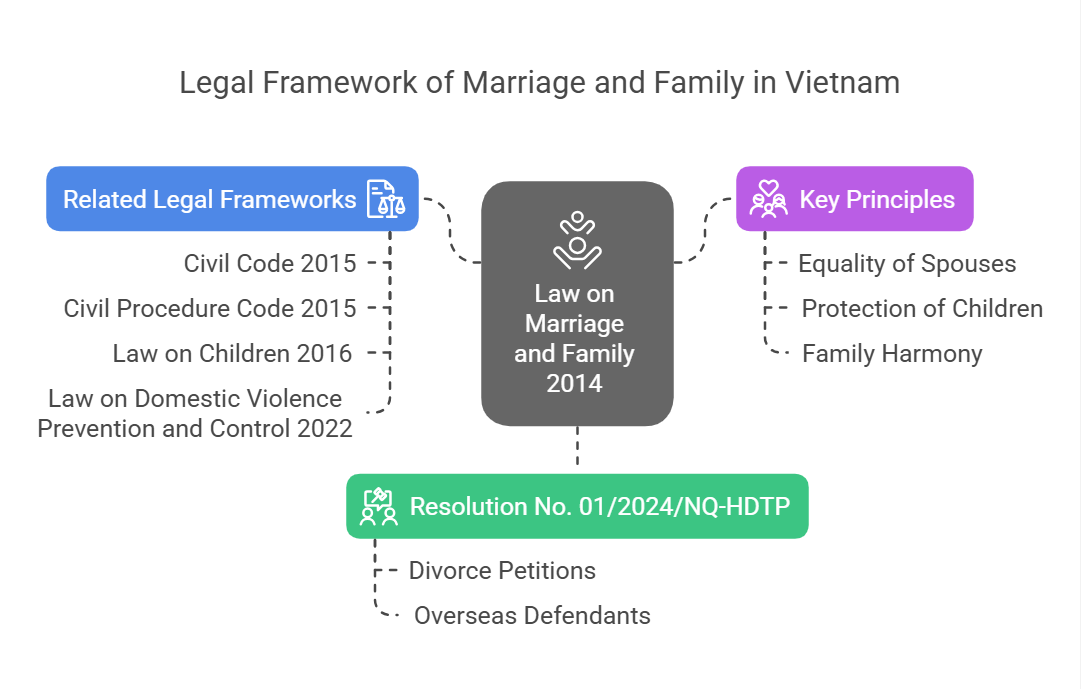
The core legal document governing marriage and family relations in Vietnam is the Law on Marriage and Family 2014. This comprehensive legislation establishes the legal framework for various aspects of family matters, including:
Conditions for marriage and registration of marriage;
Rights and obligations of spouses during marriage;
Procedures and grounds for divorce;
Principles for dividing marital property upon divorce;
Child custody, guardianship, and adoption;
Parental rights and responsibilities.
Notably, the recently published Resolution No. 01/2024/NQ-HDTP dated May 16, 2024 has provided more specific guidelines and interpretations of the Law on Marriage and Family 2014. It aims to clarify certain provisions and address practical issues that arise in resolving marriage and family disputes, such as the right to petition for divorce and resolution of divorce cases involving overseas defendants with unknown addresses.
Overall, key principles underpinning family law in Vietnam include equality of spouses, protection of children’s best interests, and mutual support within the family. Vietnam Law on Marriage and Family also subtly reflects ingrained Vietnamese cultural values that emphasize the family as the fundamental unit of society, prioritizing harmony, filial piety, and the preservation of family bonds. This cultural emphasis influences how disputes are approached, with a strong preference for amicable resolutions that preserve family ties whenever possible.
While the Law on Marriage and Family is the primary legislation for marriage and family matters, several other legal frameworks play a role in specific aspects of family disputes; including but not limited to:
Civil Code 2015: Governs general civil matters, including property rights, contracts, and inheritance, relevant in cases of property division upon divorce and inheritance disputes.
Civil Procedure Code 2015: Establishes the procedural rules for resolving civil disputes in Vietnamese courts, including marriage and family law cases.
Law on Children 2016: Focuses on the rights and protection of children, providing additional guidance in child custody and guardianship cases.
Law on Domestic Violence Prevention and Control 2022: Addresses issues of domestic violence and provides legal remedies for victims of abuse.
Other relevant Decrees and Circulars: Provide more detailed guidance on the implementation of the Law on Marriage and Family and other relevant laws, often pertaining to specific dispute resolution mechanisms.
In Vietnam, disputes in contested divorce proceedings generally fall under the People’s Court jurisdiction, with specific types of disputes listed in Article 28 of Civil Procedure Code 2015. District Courts typically handle more straightforward cases, while Provincial Courts may handle more complex or appealed cases.
Related articles:
Understand Property Division after Divorce in Vietnam
The Psychological Impact of Divorce on Children
3. Common Aspects of Marriage and Family Disputes in Vietnam
3.1. Property Division during Marriage/upon Divorce
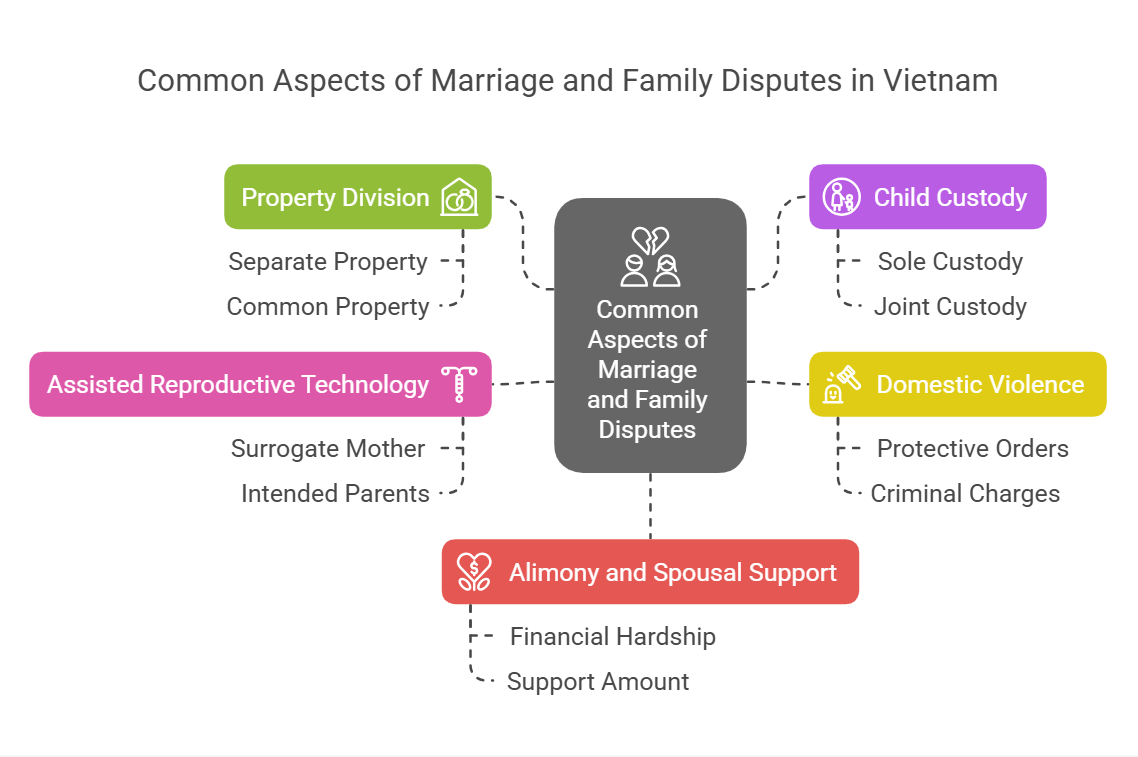
Disputes concerning property can arise both during the marriage and, more commonly, during divorce proceedings. These disagreements often center on the distinction between separate and common property. Separate property generally refers to assets owned by one spouse before the marriage or received as a gift or inheritance during the marriage. Common property, on the other hand, typically includes assets acquired by either spouse, profits arising from separate property, and other lawful incomes in the marriage period. Reaching a mutual property division settlement can be complex, especially when assets have been merged or their value has increased during the marriage. Disputes may also emerge regarding the management and utilization of jointly held assets during the marriage.
Courts typically aim for an equitable division of marital property, considering factors such as the circumstances of each spouse, each spouse’s contribution to the common property, and each spouse’s faults in the infringement of spousal rights and obligations.
3.2. Child Custody Arrangements upon Divorce
Disputes regarding child custody are frequently a central element of divorce proceedings. A primary area of conflict is deciding custody rights, with disagreements over sole or joint custody. Courts typically grant custody to the parent who can best provide stability and care, often favoring mothers for children under 36 months unless exceptional circumstances exist. Meanwhile, if a child is full 7 years or older, his/her desire of choosing the custodial parent shall be considered by the court.
Relocation issues add another layer of complexity, where one parent might plan to move to another city or country with the child, potentially impacting the child’s upbringing and the non-custodial parent’s visitation rights. Ultimately, Vietnamese courts prioritize the child’s best interests, focusing on their physical, emotional, and mental well-being while encouraging parents to reach amicable agreements whenever possible.
To proactively address potential disputes surrounding property division and child custody arrangements upon divorce, many couples choose to establish prenuptial agreements before marriage. While not explicitly defined and recognized under family law documents in Vietnam, such agreements—if meeting certain legal requirements—are legally enforceable and provide a structured framework for effective dispute resolution.
3.3. Domestic Violence
While not always culminating in divorce, domestic violence is a serious issue that often necessitates legal intervention. Domestic violence encompasses physical, emotional, economic, and sexual abuse within a family context. Disputes can arise concerning protective orders designed to safeguard victims, criminal charges against perpetrators, and other legal remedies available to those who have experienced abuse.
These cases can involve both criminal and civil proceedings, with jurisdiction often shared between criminal courts and the People’s Courts handling family matters. Decisions are based on the Law on Domestic Violence Prevention and Control 2022, the Criminal Code 2015, and the Law on Marriage and Family 2014, which provide a framework for protection orders, criminal prosecution, and other remedies. Notably, Decree 76/2023/ND-CP issued by the Government has introduced updated regulations for the Law on Prevention and Control of Domestic Violence. Effective from December 25, 2023, the decree provides detailed guidance on identifying acts of domestic violence and ensuring more comprehensive legal support for victims.
3.4. Disputes over Giving Birth Using Assisted Reproductive Technology and Altruistic Gestational Surrogacy
With advancements in medical technology, disputes related to assisted reproductive technology (ART) and altruistic surrogacy have become increasingly prevalent in Vietnam in recent years. These disputes often involve complex ethical, emotional, and legal considerations. Common disputes in altruistic surrogacy arrangements arise when the surrogate mother develops an emotional bond with the child during pregnancy and subsequently refuses to hand over the child to the intended parents. Conversely, disputes can also occur when the intended parents refuse to accept the child, often due to the child being born with a congenital disease or disability, such as Down syndrome. The People’s Court has jurisdiction to resolve disputes related to surrogacy and other ART matters.
In Vietnam, altruistic surrogacy has only been legally recognized for about a decade, officially acknowledged in the 2014 Law on Marriage and Family. To uphold ethical standards and prevent exploitation in altruistic surrogacy, Vietnamese law imposes stringent requirements on both those requesting surrogacy and surrogate mothers, as well as stipulating clear rights and obligations for each party. However, certain legal shortcomings still persist, due to the nuanced ethical and practical challenges of this practice.
On the other hand, it is crucial to emphasize that commercial surrogacy is strictly prohibited under Vietnamese law. Those who engage in commercial surrogacy arrangements, in the event of disputes, are not legally protected and may face potential fines or civil charges.
3.5. Alimony and Spousal Support
While disputes over spousal support are less common than those concerning child support, they remain a crucial aspect of divorce proceedings. Under Vietnamese law, spousal support may be granted when one spouse faces significant financial hardship and is unable to meet their basic living needs post-divorce. Courts typically assess factors such as the health status of the dependent spouse, which may affect their ability to work, and the financial capacity of the paying spouse to determine the reasonable support amount and method.
In practice, while both child and spousal support matters are important, child support obligations often take priority in Vietnam’s uncontested divorce proceedings.
4. Main Methods of Marriage and Family Dispute Resolution in Vietnam
4.1. Negotiation
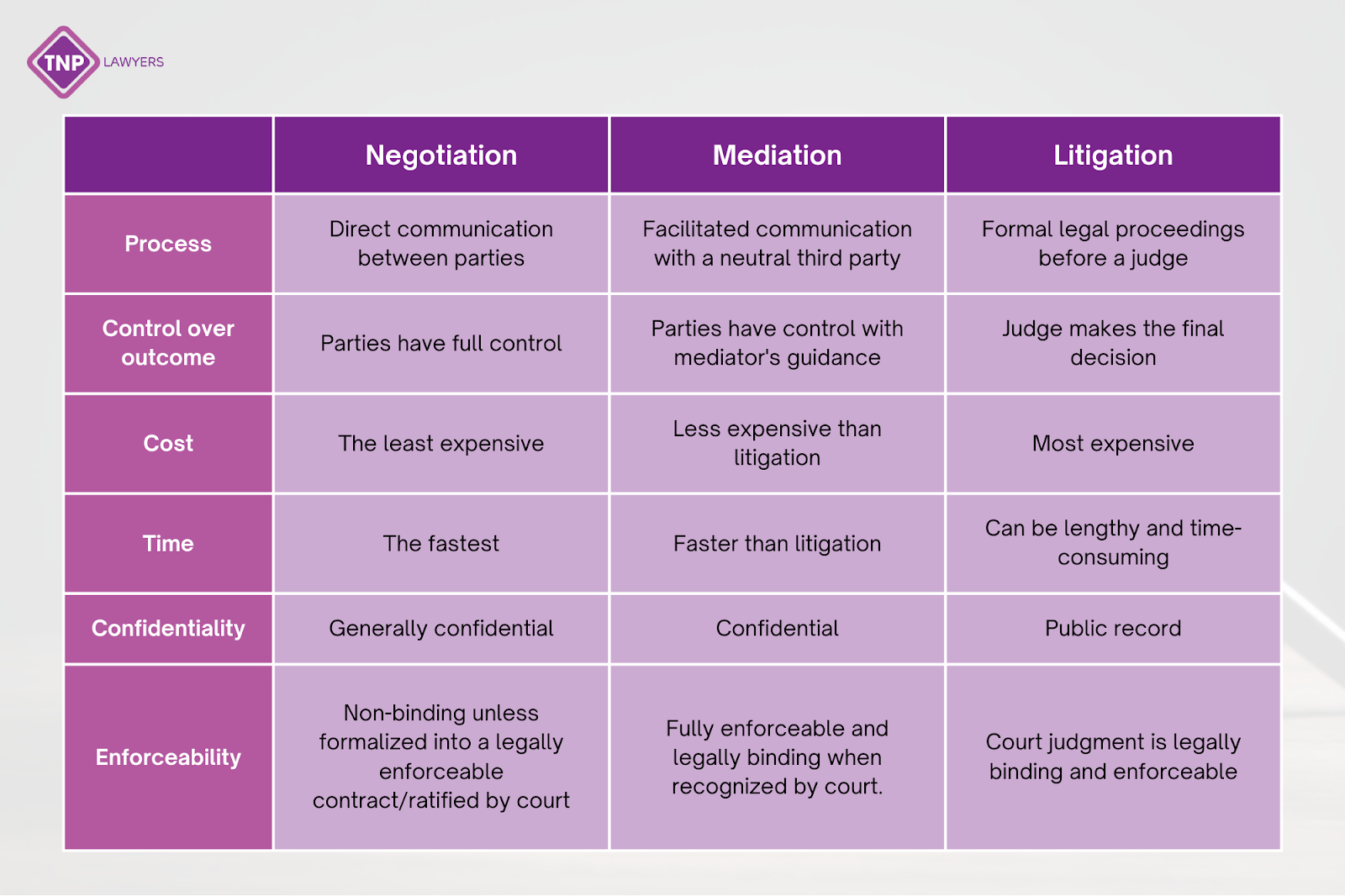
Negotiation, in the context of marriage and family dispute resolution, involves direct communication and discussion between the parties involved, with the goal of reaching a mutually acceptable agreement. This method is often the most informal, flexible and cost-effective approach to resolving family conflicts, allowing parties to maintain control over the outcome and potentially preserve relationships. Negotiation in this context might involve personal discussions about the division of marital property upon divorce, crafting workable child custody arrangements, or determining appropriate spousal support.
It is important to note that agreements reached through negotiation are not legally binding unless they are formalized into a legally enforceable contract or ratified by a court.
4.2. Mediation
Mediation involves the intervention of a neutral third party, known as a mediator, who facilitates communication and helps the parties reach a voluntary agreement. The mediator does not provide legal advice, but rather guides the discussion and helps the parties identify common ground. Mediation is a confidential process that can be particularly effective in family disputes, as it focuses on resolving conflict constructively and preserving relationships.
Reflecting this emphasis on amicable resolutions, mediation is a mandatory procedure for divorce cases in Vietnam. This aims to encourage divorced couples to resolve their disputes through discussion and, if possible, achieve reconciliation before resorting to litigation.
The written mediated settlement agreement, on the one hand, will be valid and have binding effect on the disputing parties in accordance with the provisions of civil law. To become fully enforceable, on the other hand, the agreement must be recognized by court. This process involves the court reviewing the agreement and issuing a formal decision, transforming it into a legally binding final court judgment.
4.3. Litigation
When negotiation and mediation efforts prove unsuccessful in resolving family disputes, involved parties may initiate formal legal proceedings through court litigation. This involves filing a lawsuit with the appropriate court and presenting evidence and arguments before a judge. The judge then makes a legally binding decision that resolves the dispute.
Compared to negotiation and mediation, litigation is a more formal and adversarial approach, and is generally considered the last resort in family disputes. It typically entails greater expenditure of time and financial resources. The documentation required for litigation generally includes a formal petition, identification documents for all parties, a marriage certificate (where applicable), birth certificates of any children involved, documentation pertaining to property ownership, and any other evidence related to the specific claims made. Enforcement of court judgments, if necessary, is executed by competent authorities following the issuance of the judgment.
In the following table, we provide a comparative overview of the aforementioned dispute resolution methods:
5. Conclusion
When facing the struggles of a marriage and family dispute in Vietnam, a thorough understanding of the legal landscape and familiarity with family court procedures is essential. As we’ve discussed, these disputes can range from disagreements over property division, child custody to spousal support, domestic violence, and even the complex considerations surrounding surrogacy. Vietnam Law on Marriage and Family 2014, along with other relevant legislation, provides legal framework for addressing these issues by offering various paths to resolution. Each method offers a distinct approach, so choosing the right path is a deeply personal decision, one that can significantly impact the legal outcomes.
During these challenging times, professional legal guidance can provide valuable personalized strategies for your case. A skilled family law attorney can offer excellent legal counsel and even emotional support, helping you understand your legal rights in marriage-related disputes and make informed decisions that support your long-term well-being. Legal representation in family matters can mitigate further conflict and facilitate more favorable resolutions, while aligning with cultural sensitivity of Vietnam family law.
If you’re dealing with a marriage or family dispute in Vietnam, TNP Lawyers can provide the guidance and support you need. We understand the intricate nature of these matters and are dedicated to offering effective, culturally-sensitive legal solutions. Our commitment is to achieve the best possible outcome for your individual situation, so that your legitimate rights and benefits are safeguarded throughout the process. Contact TNP Lawyers today for a private consultation and secure your future.
Ho Chi Minh City Office Locations:
- Level 11, Vincom Tower, 72 Le Thanh Ton Street, Ben Nghe Ward, District 1
- Vinhomes Grand Park, Nguyen Xien Street, Long Thanh My Ward, District 9
- Phone: (+84) 909 128 420
- Email: nathy.nguyen@tnplawyers.com
- Website: www.tnplawyers.com